
Choose A Working Discipline
Becoming a commercial diver is a decision about a working discipline, not simply about spending more time underwater. The role involves physical tasks, equipment preparation, communication and close coordination with a surface team. A recreational diving certificate does not automatically qualify someone for that work.
The first practical question is whether the training you are considering fits the work and location you have in mind. The next is how you will demonstrate fitness and competence honestly. A course can provide a qualification, but a useful career decision also needs a realistic understanding of the tasks, responsibilities and limits that follow it.
Check Recognition Before Choosing Training
Training must be appropriate to the equipment, tasks and jurisdiction. Before choosing a course, ask what qualification is awarded and where it is recognised. Check recognition with the authority or employer where you expect to work. An attractive course description does not settle that question.
Requirements differ between countries. Do not assume that acceptance in one place establishes acceptance everywhere the group operates. If a provider makes a broad statement about employment opportunities, turn it into a specific question about the qualification and intended work. Keep the answer connected to the region you are actually considering.
Specialist tasks can require additional competence beyond an initial diving qualification. Avoid treating an entry qualification as evidence that you can already perform every type of underwater work. It is more useful to identify what the training covers, what it does not cover and what an employer would need to assess before assigning a particular task.
Understand Fitness And Working Conditions
Medical fitness is essential, and assessment must follow the applicable rules. No general guide can determine whether an individual is fit to dive or identify the medical documentation required for every location. Confirm the relevant requirements rather than relying on a general description of the role.
The role involves physical work, restricted access and poor visibility. Those conditions place importance on preparation and communication, not just confidence in the water. Consider whether you understand the difference between completing a practical task as part of a supervised team and diving for recreation.
Ask prospective employers about the actual work involved. Civil underwater tasks can include inspection, maintenance and repair of submerged structures. The range of services on a website does not mean a new diver will immediately perform all of them. Use those descriptions to form informed questions, not to assume a particular first assignment or level of responsibility.
Build An Honest Record Of Competence
Keep training, medical and experience records current. Describe equipment and task experience specifically. A list of impressive depths says less about suitability than a clear account of the work performed and the conditions under which it was completed. Give an employer information that can support an assessment.
Distinguish what you observed, what you assisted with and what you personally performed. These are all useful parts of experience, but they are not interchangeable. If your role was on the surface, describe it accurately. Do not turn involvement in a team’s operation into a claim that you personally carried out every underwater task.
Be equally clear about gaps. An initial qualification does not remove the need for further support or task assessment. An employer needs to understand where your experience ends. Presenting those limits honestly gives the discussion a sounder basis than broad claims that require correction when the details are examined.
Treat Surface Duties As Part Of The Job
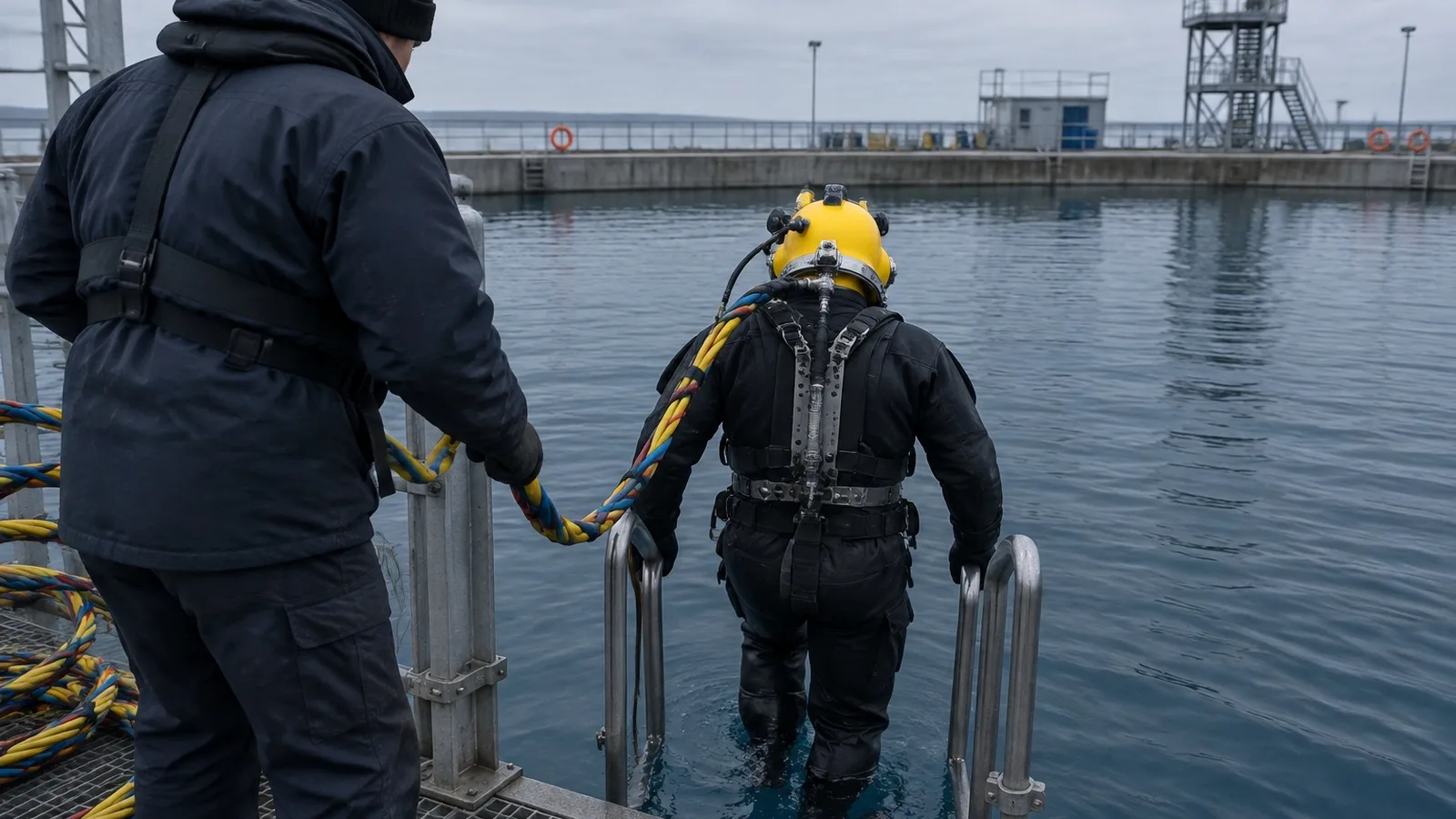
A new diver needs to understand briefings, equipment checks, communications and the supervisor’s instructions. Surface duties are part of the operation. They are not a lesser form of participation to be ignored while waiting to enter the water. Preparation and handover contribute to the work of the whole team.
Reliability matters in those activities. Ask for clarification when you do not understand a task or instruction. Confidence without a shared understanding can hide a gap that the supervisor needs to know about. An accurate explanation of your experience is useful during the work as well as during recruitment.
There is no promised timetable from qualification to independent work. Progress depends on competence, the task and the employer’s assessment. Complete paperwork does not establish readiness for every assignment. An experienced supervisor plays a key role in recognising when a candidate needs more support. Keep that distinction between qualification and demonstrated competence in mind when discussing progression.
What To Ask And What To Send
Start With Accurate Expectations
A sound application does not need exaggerated experience or a promised career timetable. It needs recognised training appropriate to the intended work, attention to medical requirements and an honest account of competence. It should also show that you understand the place of preparation, communication and surface duties.
Use unanswered questions to guide the next conversation with a training provider, authority or employer. Confirm recognition before committing to a course. Confirm the role before assuming what your first work will involve. That approach keeps the decision grounded in the work you are actually seeking, rather than in an appealing but incomplete picture of commercial diving.
- Ask which qualifications are recognised for the intended region and tasks.
- Confirm how the applicable medical requirements will be checked.
- Keep an accurate record of training, equipment experience and practical duties.
- Explain your qualifications, languages and preferred region in your application.
- Distinguish observed work, assisted work and tasks you personally performed.