
Write For Someone Who Was Not There
An underwater damage record may be read months later by people who never attended the site. It needs to explain what was observed, where it was observed and when. A file that depends on the original team’s memory is not a self-contained record.
The task is to preserve evidence in a form that can be followed. That does not mean predicting an insurer’s conclusion or promising that a claim will be accepted. It means making the recorded condition, the limits of the inspection and the sequence of decisions understandable without an informal explanation.
Put Location And Time Beside The Evidence
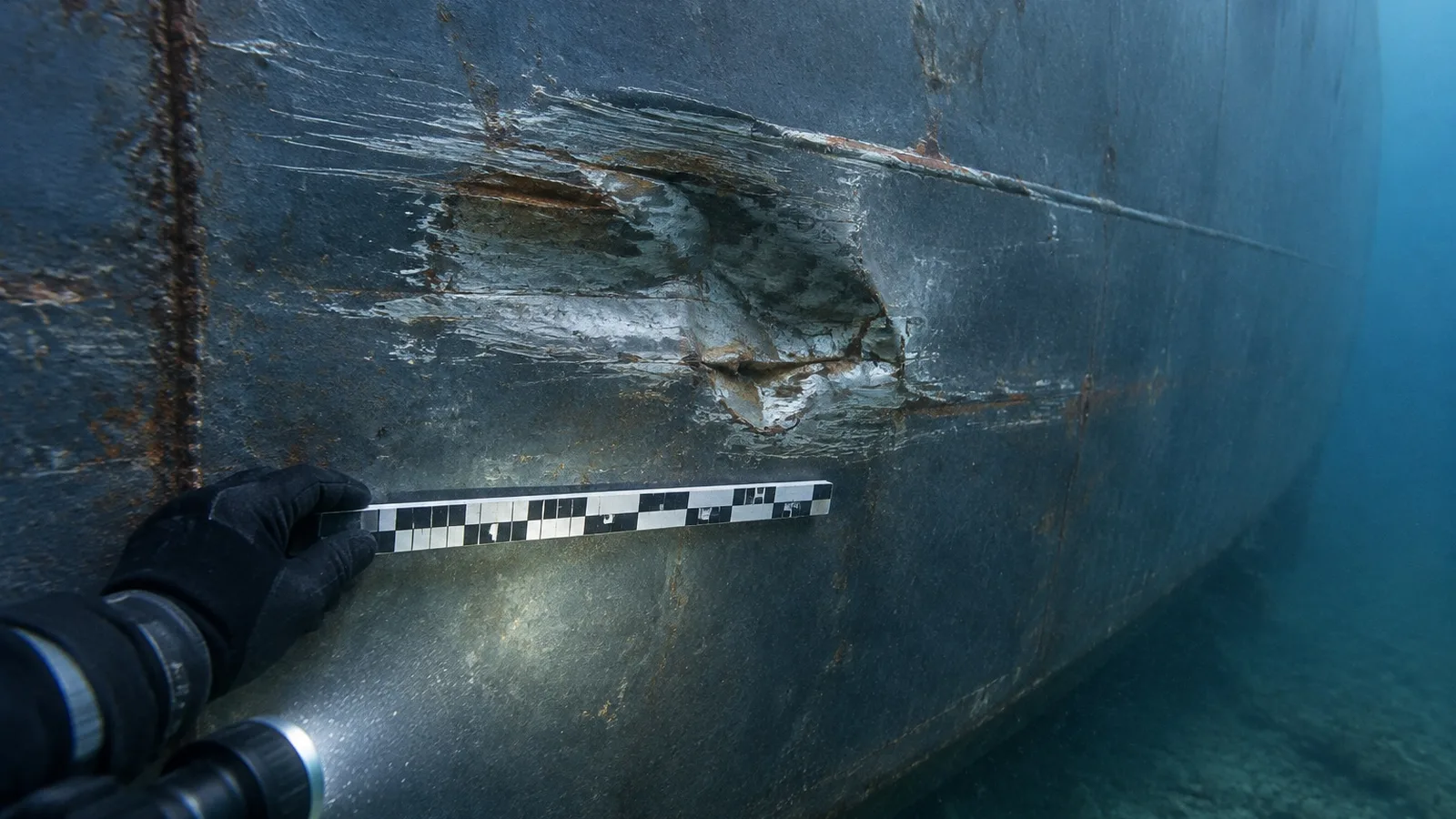
Footage without location references is a common weakness. A reader may see damage clearly but still be unable to place it on the vessel or structure. The record should connect the description, the supporting image and the location rather than asking the reader to work out that relationship.
Use references consistently across the findings and the visual record. Where a defect register is used, location, type, extent and photograph reference help make an entry traceable. The objective is to let another person move from the written account to the relevant evidence without searching the whole collection.
Time references also matter when the condition changes during an intervention. Identify when the observation was recorded and keep the sequence clear. A later image should not be allowed to stand silently for the original condition. Even clear footage can be misunderstood if the reader cannot place it in the sequence of events.
Preserve The Condition Before Intervention
A missing baseline is another common shortcoming. Without a record of the condition before intervention, later readers may be unable to separate what was found from what changed during the work. Recording afterwards does not restore the lost opportunity to document the original situation.
The casualty assessment sequence begins by recording the situation as found, with time stamps. That is useful discipline for damage documentation as well. Keep that evidence identifiable, rather than mixing it into later records without explaining when each part was made.
Do not imply that a baseline answers every question about the incident. It records a condition at a particular stage. Questions about cause or the meaning of a finding may still require interpretation. Its value is that those discussions can refer to a preserved observation rather than depend only on a later account of what people remember seeing.
Keep Conclusions Separate From Observations
A description of visible damage is not the same as a conclusion about its cause. Presenting conclusions as observations is a recognised reporting weakness. It hides the reasoning and makes it harder for a surveyor or another reader to distinguish evidence from opinion.
Write the observation first and identify the supporting record. Then explain any interpretation as an interpretation. If the available evidence does not resolve a question, state that limit rather than completing the account with an assumption. A clear gap is more useful than an unsupported conclusion that appears settled.
Use the same approach when comparing earlier and later records. Confirm that the locations and coverage can be matched before describing a change. If the records are not directly comparable, explain why. The purpose is not to avoid conclusions, but to make their basis visible so that another reader can understand how they were reached.
Document Decisions Alongside The Damage
A damage file can be incomplete even when it contains useful images. Missing information about who was present and what was decided leaves the sequence difficult to reconstruct. Keep a decision record that can be read alongside the findings rather than relying on scattered recollections.
Separate a finding, a proposed action and a completed action. These are different stages. A recommendation in a report does not show that the work was carried out, and a decision to investigate does not mean the uncertainty has been resolved. Clear status avoids giving later readers an inaccurate picture of progress.
The record should also show the information available when a decision was made. This helps distinguish the original basis for the decision from knowledge obtained later. Do not silently rewrite the earlier account to reflect a later understanding. Preserve the sequence so the reader can follow how the assessment developed.
What To Send With The Damage Record
Organise the material around the questions the record needs to answer. A large volume of footage does not compensate for missing references or an unclear sequence. A short explanation of how the files relate to the findings can make the evidence easier to use.
Before sending the record, read it without relying on site knowledge. Check whether each important statement can be connected to an observation, a clearly marked interpretation or a recorded decision. Where information is absent, identify that absence rather than leaving the reader to guess.
- Include the inspection scope, date and recorded conditions.
- Provide location references that match the findings and images.
- Identify the record of the condition before intervention.
- Keep later observations distinguishable from that original record.
- Separate observations from conclusions and explain unresolved questions.
- Include the log of who was present and what was decided.
- Make the status of proposed and completed actions clear.
Close With Limits As Well As Findings
A useful closing summary states what the record establishes and what it leaves open. It should not broaden a limited observation into a conclusion about the whole vessel, structure or incident. Direct the reader to the supporting material rather than treating the summary as a replacement for it.
The final check is whether the file can stand alone. Someone reading it later should be able to locate the damage, follow the sequence and recognise where interpretation begins. That is the practical aim of the documentation. It supports review without making promises about how another party will assess the evidence.