
A Line Comes Loose
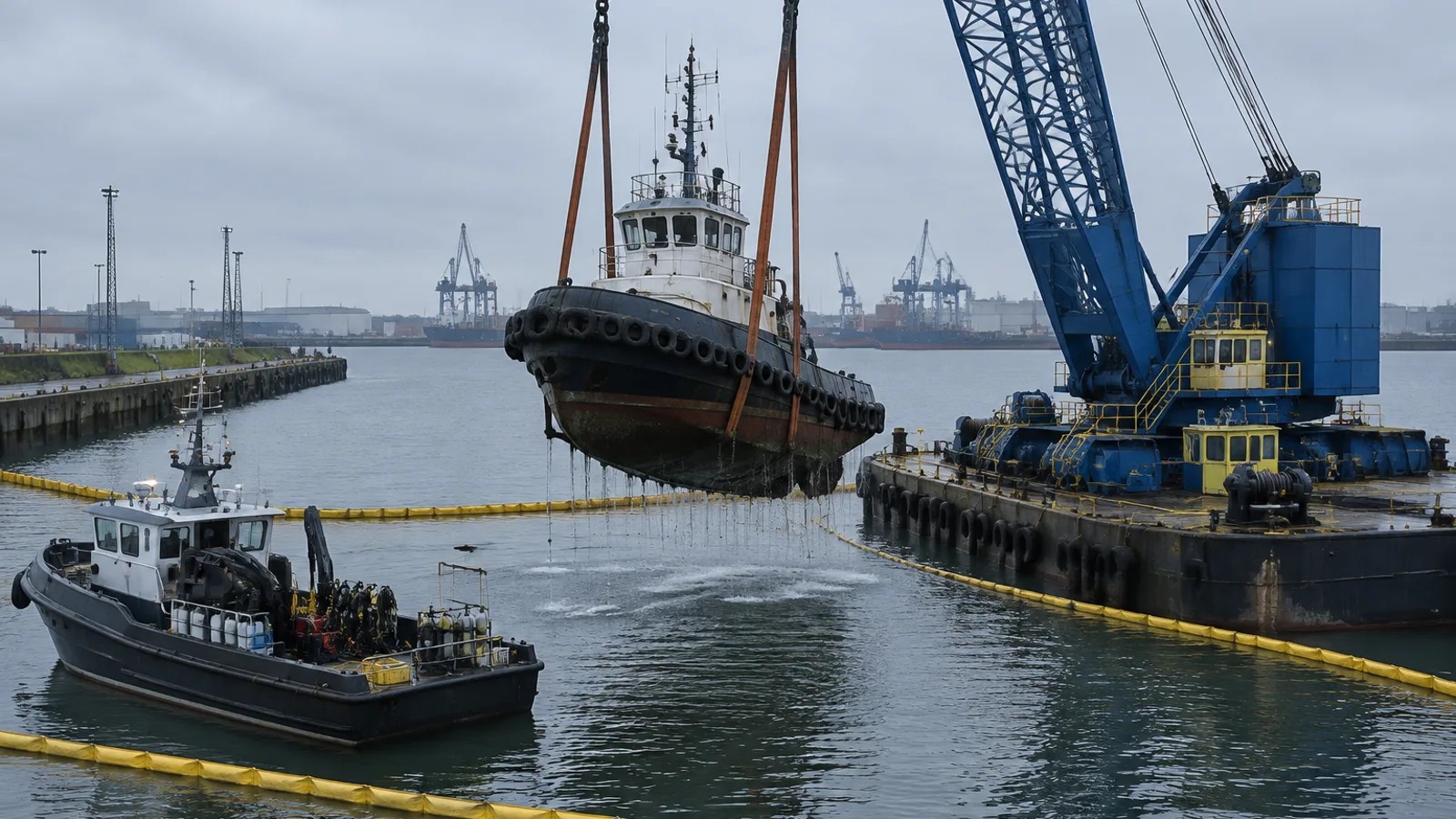
Around ten o'clock one evening, a tug sank in the port of Antwerp after a line came loose. By the following morning the task was clear: bring the vessel back to the surface, keep the oil and gas oil in her tanks from spreading, and leave her in a condition where she would stay afloat.
This article follows that salvage step by step. It is written anonymously. The tug, the floating crane and its operator are not named, and details such as the date and depth are left out. What remains is the sequence of work, and the reason each step was done in that order.
Six In The Morning
Salvage started at 06:00 the next morning. Three resources worked together: a floating crane, a dive team and the group's own vessel, its flagship. The crane would carry the load. Everything that made the lift safe and controlled had to be done first, below the surface, by the divers.
That division of work is typical of a lift salvage. The crane is the most visible part of the operation, but it can only lift what has been prepared. The quality of the underwater preparation decides whether the lift is controlled or improvised.
Preparing The Lifting Straps
The divers' first task was to prepare the lifting straps. Straps carry the full weight of a waterlogged vessel. If they are badly prepared or badly placed, the load can shift during the lift and the hull can be damaged at the point where it is most vulnerable.
Strap preparation is therefore not a formality before the real work. It is the foundation of the lift. Once the other preparations were complete, the divers connected the straps so the crane could take the load.
Keeping Oil And Gas Oil In The Tanks
A sunken tug still carries what was in her tanks. When the vessel moves or tilts during a lift, anything that can escape through an open valve or a leak will do so. The divers closed valves and sealed leaks so that oil and gas oil from the tanks could not spread into the dock.
Doing this before the lift is far easier than dealing with pollution afterwards. On the bottom, the vessel is stable and the openings can be dealt with one at a time. Once she is moving, the opportunity is gone.
A Second Line Of Defence: Oil Booms
The group also laid the oil booms around the site. Booms do not replace closing valves and leaks. They are there for the case where some product escapes anyway. Two separate measures protect the water: the first keeps product inside the vessel, the second keeps any release contained.
For an owner or port authority, this is a useful question to ask about any salvage plan. What stops pollution at the source, and what contains it if the source control is not perfect?
After The Lift: Pumps, One Compartment At A Time
Lifting a sunken vessel is not the same as making her float. When the tug came up, her compartments were still full of water. The team installed pumps and emptied the compartments one by one.
Emptying compartments in turn keeps the operation under control. The team can watch how the vessel responds as each space is cleared, rather than changing everything at once. It also makes it easier to see where water is still coming in.
Finding And Sealing The Leak
While the compartments were being emptied, the team looked for the leak. Pumps can keep ahead of incoming water for a while, but a vessel that only floats while pumps are running is not really afloat. Once the leak was found, it was sealed from the inside.
That step marks the difference between a vessel that has been lifted and a vessel that has been recovered. The team left the tug afloat on her own buoyancy, rather than handing over a vessel that depended on pumps.
Afloat Within One Morning
From the start at six, the tug was afloat again within one morning. No single step was dramatic. Each step simply made the next one possible: straps prepared before the lift, valves and leaks closed before the vessel moved, booms in the water before anything could escape, compartments emptied in turn, and the leak sealed before the team stepped back.
What Owners And Ports Can Take From It
The sequence offers practical questions for anyone facing a sunken or flooded vessel. They are general points, not a fixed procedure for every casualty.
None of these questions requires the owner to plan the salvage. They help the owner understand the plan, follow its progress and recognise when a step is missing.
- Ask what is in the vessel's tanks from the first call, and how it will be kept there during the lift.
- Ask how pollution will be contained if source control is not complete.
- Ask how the lifting straps will be prepared and who will connect them.
- Ask how the vessel will be emptied after the lift, and in what order.
- Ask what condition the vessel will be left in: afloat on pumps, or afloat on her own buoyancy.