
Why Roles Matter In The First Hours
A casualty brings together people with different duties, often within a short time and under pressure. Without clear roles, a response can turn into a series of conflicting instructions. Work stops and starts. Information is repeated, or lost. Decisions are taken by whoever happens to be on the quay.
This article sets out who usually does what during a casualty, and how an owner can keep responsibilities clear from the first call to the final handover. It is an overview for owners and managers. It does not replace the instructions of authorities or emergency services.
One Incident, Several Responsibilities
The owner needs to protect people and the vessel, and remains responsible for decisions about the ship. The harbour authority manages navigation, local permissions and the safety of other traffic. Insurers and appointed specialists assess damage and proposed measures. Contractors must execute an agreed scope safely and within their competence.
There is no universal command structure that fits every incident. The responsible parties should establish who can authorise work, who controls the affected location and who receives updates. Those arrangements need to be explicit before lifting or dewatering begins. A contractor waiting for approval should know exactly whose approval counts.
A common mistake is to assume that the most senior person present has authority over everything. Authority over the vessel, authority over the waterway and authority over the money can sit with three different parties. Write down which is which.
The First Shared Picture
Location, vessel condition, missing persons, pollution concerns and nearby traffic shape the immediate response. Authorities and emergency services must receive urgent information through the appropriate channels. A diving contractor is not a replacement for emergency services, and should never be treated as one.
Once the urgent calls are made, the parties need one shared picture. Who is on site? What is known for certain? What is only reported? Which areas are closed? A short written summary, updated at agreed times, prevents each party from building its own version of events.
- Record confirmed facts separately from estimates.
- Identify the owner’s contact and the person authorised to approve the scope.
- Agree a common incident log and update rhythm.
- Note any restrictions set by the authority on traffic, access or discharge.
The Contractor’s Role
An underwater team can assess submerged damage, support containment and execute defined recovery tasks within its competence. The engineering concept and permitted working conditions determine what follows. A diver’s observation is useful evidence, but it is not a substitute for a naval architect’s stability assessment.
The contractor should say clearly what it has seen, what it can do and what it needs before it can proceed. It should also say what it will not do without further approval. That clarity protects the people in the water and the owner’s decision-making.
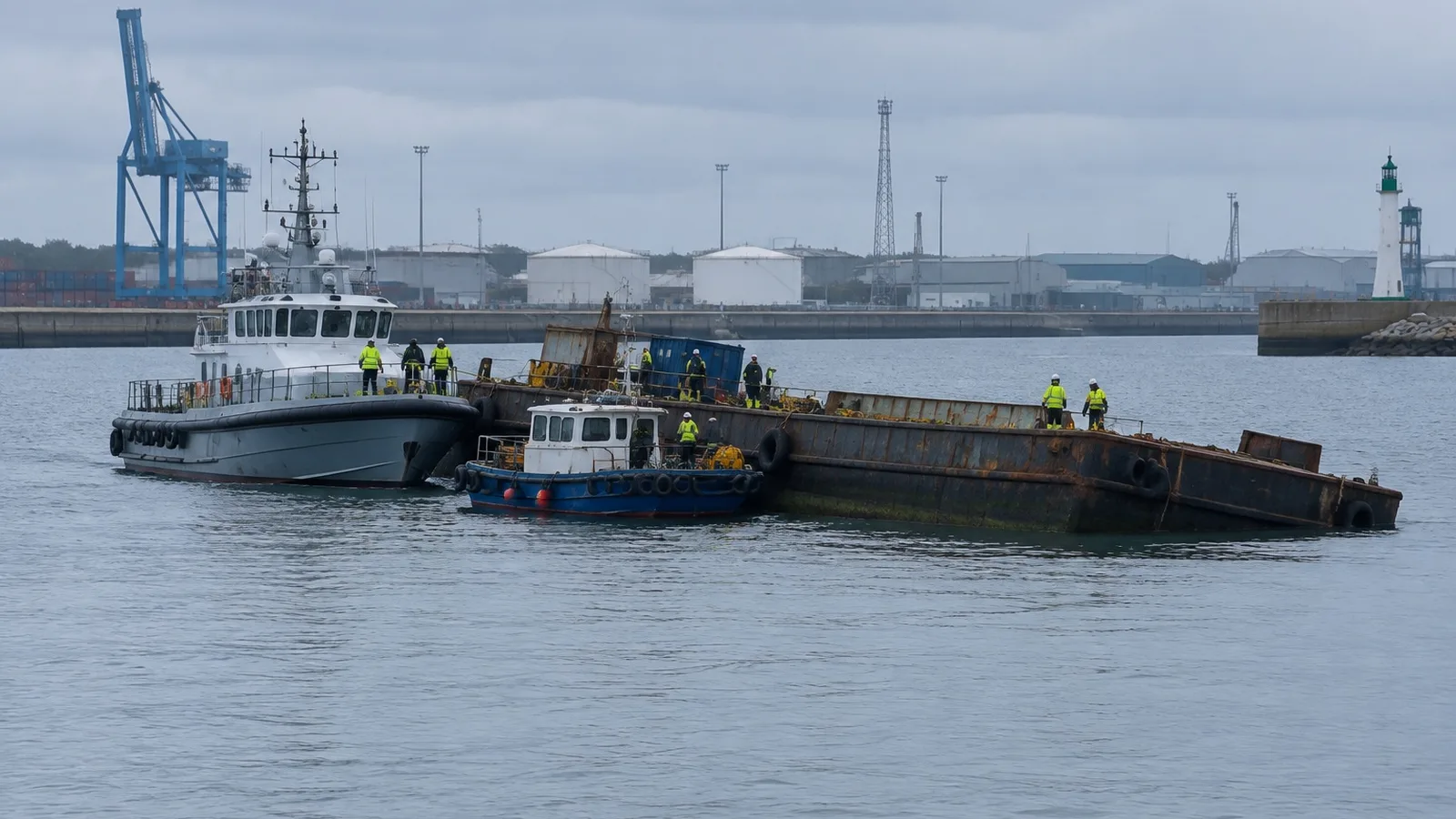
The Antwerp tug salvage illustrates the need to understand the submerged situation before attempting recovery. The recovery depended on more than lifting capacity. It depended on knowing the condition below the surface and on agreement about how to proceed.
What To Send, What To Ask, What To Check
When an owner calls a recovery team, a few pieces of information make the first conversation much more useful. A few questions make the answer more reliable.
- Send the exact location, vessel type and what has happened, as far as it is known.
- Send the name and number of the person who can approve work.
- Send any instructions already given by the authority or insurer.
- Ask what the team proposes to do first, and what it needs to start.
- Ask which approvals and permits the proposed work depends on.
- Check that the update rhythm and the incident log are agreed by all parties.
Keep Evidence As Work Progresses
A time-stamped record of observations, decisions and interventions helps both operations and later review. Keep photographs, survey findings, lifting records and disposal documentation linked to the relevant work phase. An insurer or authority reviewing the incident later will want to see not only what was done, but why and on whose approval.
Evidence is easiest to collect at the time and hardest to reconstruct afterwards. Agree at the start who keeps the log, where photographs are stored and how changes in scope are recorded. A change agreed by telephone should be confirmed in writing as soon as practical.
Common Mistakes To Avoid
Several problems appear again and again when roles are unclear. They are easy to prevent if the parties are aware of them early.
- Starting recovery work before the person authorised to approve it has agreed the scope.
- Passing estimates on as facts, so that later decisions rest on figures nobody confirmed.
- Letting each party keep its own log, so that no complete record exists afterwards.
- Agreeing changes by telephone and never confirming them in writing.
- Treating the end of the urgent phase as the end of the incident, while approvals and disposal are still open.
A Clean Handover
Handover should make it clear what is safe, what has changed and what still requires approval. The receiving party should know which areas remain restricted, which equipment is still in place and which documents support the work done. A vague handover can undo the clarity built during the response.
Clear roles do not slow a response down. They prevent the stop-start pattern that follows when nobody is sure who decides. Agreeing them early, and writing them down, is one of the simplest things an owner can do to keep a difficult day under control.